A Restless Electorate: Growing Discontent with Trump’s Second Term
A little over a year into his second presidency, public patience appears to be thinning for Donald Trump. A recent ABC News/Washington Post/Ipsos poll conducted between February 12–17, 2026, among 2,589 U.S. adults reveals broad dissatisfaction across nearly every major policy domain.
Overall presidential approval stands at just 39%, while 64% of respondents say Trump is out of touch with every day Americans. On specific issues, the numbers are more striking:
· 65% disapprove of his handling of inflation,
· 64% oppose his tariff strategy,
· 62% criticize foreign relations,
· 58% fault immigration tactics, and
· 57% disapprove of his management of the economy.
None of these areas earns majority approval—an ominous sign ahead of the 2026 midterms.
The Tariff Tirade and Economic Anxiety
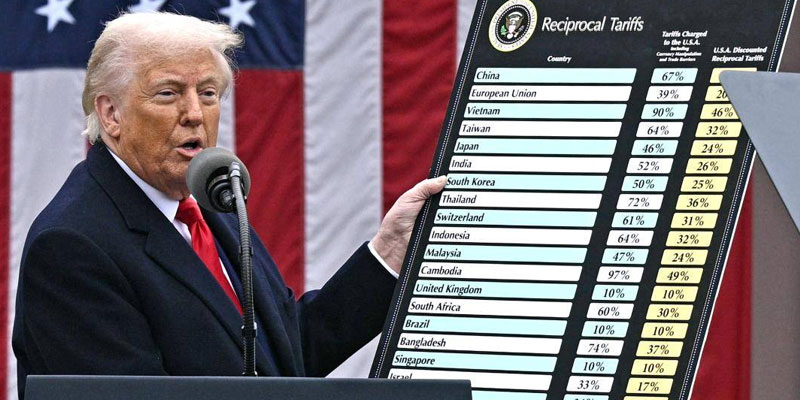
At the center of public frustration lies Trump’s aggressive tariff campaign targeting China, Mexico, and other trade partners. Marketed as a protectionist shield for U.S. manufacturing, the approach has instead fueled fears of rising consumer prices and supply chain disruptions. With 64% disapproval on tariffs, Americans appear unconvinced that trade barriers are easing cost-of-living pressures.
Inflation remains the administration’s most vulnerable flank. Despite Federal Reserve tightening and moderate growth indicators, 65% disapprove of Trump’s inflation management. Nearly half (48%) believe the economy has worsened since his January 2025 inauguration, compared with only 29% who see improvement. Cost-of-living concerns continue to overshadow macroeconomic growth data.
The partisan split is sharp. Roughly 75% of Republicans support Trump’s tariff policies, while 95% of Democrats and 72% of independents oppose them. This polarization sustains Trump’s base but limits his cross-party appeal. Independent voters—often decisive in midterm cycles—show pronounced skepticism, compounding Republican electoral risk.
Immigration and Foreign Policy Strains
Immigration, traditionally a Trump stronghold, reveals a more complex landscape. While mass deportations split the public nearly evenly (50% support, 48% oppose), 62% disapprove of enforcement tactics linked to ICE operations. Overall immigration approval stands at 40%, reflecting discomfort with methods rather than necessarily objectives.
Foreign policy disapproval (62%) further complicates the administration’s narrative. Strained NATO relationships, recalibrated Ukraine support, and escalating tensions with China contrast with Trump’s “America First” positioning. Critics argue that economic pain and diplomatic volatility have outweighed perceived security benefits.
The poll also precedes a Supreme Court decision striking down elements of Trump’s tariff regime—an outcome that could either validate critics or galvanize supporters who view judicial pushback as institutional resistance.
Political and Global Implications
Domestically, sustained negative ratings signal early second-term erosion reminiscent of Trump’s first presidency—but now amplified by economic fatigue. Though Republicans remain largely unified, independents’ discontent presents a structural vulnerability ahead of 2026 congressional races.
Globally, U.S. tariff volatility reverberates through trade corridors, including the $200 billion-plus U.S.–India economic partnership. Higher import costs in electronics and pharmaceuticals, coupled with commodity-linked inflation, create spillover pressures for emerging markets.
Yet Trump retains pockets of resilience. On immigration trust metrics, he edges out Democrats slightly, suggesting cultural and border security themes could re-energize his coalition. A pivot toward tax cuts or energy policy in upcoming addresses may attempt to reset the narrative.
A Mandate Under Pressure
The latest polling paints a clear picture: while Trump’s base remains intact, the broader electorate is signaling fatigue with economic turbulence and confrontational trade policies. Disapproval exceeding 60% on multiple fronts is not merely statistical—it is politically consequential.
Whether this moment represents temporary dissatisfaction or deeper mandate erosion will depend on economic stabilization and policy recalibration. For now, the message from voters is unmistakable: bold rhetoric must translate into tangible relief, or the political costs will continue to mount.
(With agency inputs)